
2026/04/22 | Andrés Pérez M., Vittorio Peretti, Andrea Tellechea & Ignacio Martínez
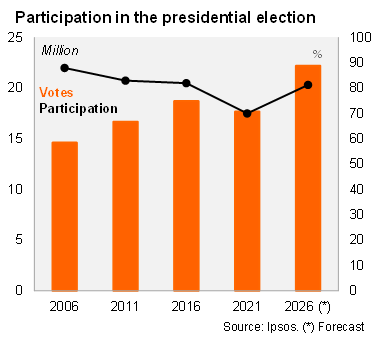
Peru held general elections on Sunday, April 12, marked by a highly fragmented presidential race and the reintroduction of the Senate. Voters elected the full Chamber of Deputies (130 seats) and reinstated the Senate (60 seats) following a constitutional reform that ended the unicameral system in place since 1993. With 35 presidential candidates, and polls pointing to more than 30% of undecided voters, the election was wide open. The election day was marked by operational challenges, resulting in certain voting districts reopening on the Monday, while the vote count has dragged on, with the final tally expected only in May. Preliminary Congressional results point toward the political right having strong representation but falling short of a majority in either chamber. Voting was compulsory, with Ipsos putting turnout at a tick over 80%, well above the 70.0% registered in the 2021 general elections.
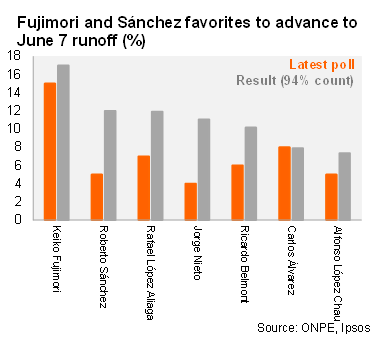
With 94% of the presidential vote counted, the preliminary vote count places perennial candidate Keiko Fujimori against Roberto Sánchez (minister during Pedro Castillo’s administration) in the June 7 runoff. Roberto Sánchez’s lead over former Lima mayor Rafael López Aliaga is only 15 thousand (out of more than 20 million votes), so the result is not certain. However, as rural votes still come in, Sánchez’s advantage might grow at the margin. Keiko Fujimori leads with 17% of the vote, followed by Sánchez (12.01%), López Aliaga (11.92%), and former minister in the PPK administration, Jorge Nieto (11.06%). While polls had consistently anticipated a runoff, there was also a significant share of undecided voters. Comedian Carlos Álvarez had generally been polling in second spot, eventually capturing 7.9% of the vote (broadly in line with the polls), to place sixth overall. Sánchez, López Aliaga, and Nieto were key beneficiaries of late deciders.
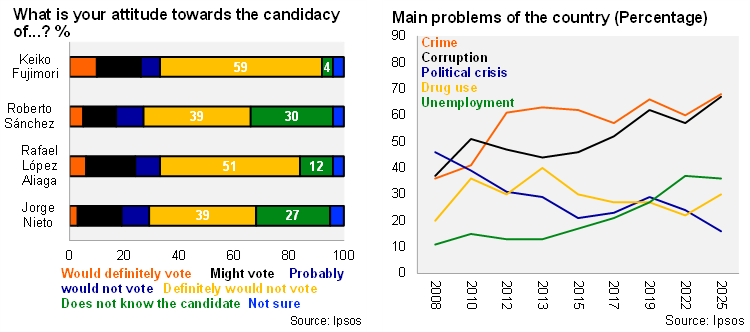
Is the fourth time a charm for Fujimori? Keiko Fujimori has reached Peru’s presidential runoff stage three times prior to 2026, narrowly losing on each occasion. In the 2011 election, she was defeated by Ollanta Humala in the second round, securing 48.6% of the vote against Humala’s 51.4%. She returned to the runoff in 2016, winning the first round but losing the presidency to Pedro Pablo Kuczynski, who edged her out with 50.1% to 49.9%. Most recently, in 2021, Fujimori again fell short in the runoff, losing to Pedro Castillo by an even narrower margin, obtaining 49.87% versus Castillo’s 50.13%, a difference of roughly 44,000 votes. If confirmed in 2026, this would mark her fourth consecutive appearance in a presidential runoff, an unprecedented record in Peruvian politics. Polls suggest Fujimori’s rejection rate is above 50%, hampered by a broad anti-Fujimorista coalition. Polls prior to the election showed that Sánchez had one of the lowest recognition rates (around 30% unknown). Polls consistently highlight concerns about public safety, crime, and extortion.
Vastly diverse political platforms on offer. Keiko Fujimori (Fuerza Popular) advocates an agenda focused on economic stability, private investment, and public security. Her platform emphasizes maintaining the current constitutional and economic framework, promoting business formalization, reducing regulatory burdens, and strengthening investor confidence, particularly in mining and infrastructure. On fiscal policy, Fujimori favors targeted tax incentives, support for SMEs, and spending efficiency rather than major tax hikes. Roberto Sánchez (Juntos por el Perú) runs on a Castillo‑aligned platform that calls for a new Constitution to redefine the economic role of the State and recognize Peru as a plurinational country. His economic agenda stresses greater state intervention in strategic sectors, particularly mining and energy, including contract reviews, higher royalties, and taxation of windfall profits, while publicly ruling out expropriations.
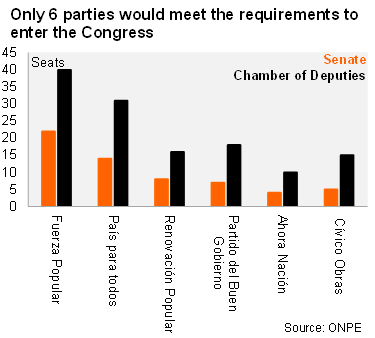
The return of the Senate may add a layer of political stability. Turning to the legislative elections, with around 80% of ballots counted, Congress is set to become less fragmented, and more focused on market-oriented reforms. So far, only six parties have surpassed the 5% threshold and the minimum requirement of seven lawmakers to obtain representation in Congress. In the last cycle the number of parties in Congress reached 10. In our view, this configuration could lead to a more disciplined senate and lower chamber, helping to reduce the historically high level of tension between the Executive and Legislative branches.
Our take:
- Short-term macro challenges for the incoming administration. The incoming administration will face the economic repercussions of higher global oil prices stemming from the Middle East conflict; the BCRP estimates that a 10% increase in international oil prices leads to 0.2 pp in annual inflation. Separately, risks of an “El Niño” weather phenomenon have increased; warmer ocean temperatures this year, would have a transitory negative impact on fishing and agricultural output towards 1Q27. The BCRP estimates that prior El Niño events have boosted inflation by 0.58 pp (through food shortages) and dented annual GDP growth by 0.1pp.
- Plenty of opportunities to boost growth. The mining-related investment upswing is set to continue, supported by strong terms-of-trade, amid historically high copper and gold prices. Political stability and focus on reducing regulatory red tape could accelerate several mining projects trapped in bureaucratic blockades, while pro-market reforms may boost investor confidence further.
- 2026 GDP growth roughly at potential. The 2026 election comes after several years of political turmoil, marked by frequent leadership changes and multiple former presidents either removed from office or facing judicial proceedings. Notwithstanding, Peru’s economy has shown notable resilience, weathering episodes of financial volatility with limited macroeconomic disruption. Elevated metal prices and strong macroeconomic fundamentals have supported economic stability. We expect GDP growth of around 3.1% in 2026, broadly in line with estimated potential, while core inflation is projected to remain within the central bank’s target range of 2% ±1%. The runoff election is scheduled for June 7, with the new administration set to take office on July 28.
- BCRP succession in focus. Highly respected Governor Julio Velarde will conclude his fourth five-year term at the helm of the BCRP in July, 2026. The incoming president is expected to nominate his successor or reappoint Velarde, along with three other members of the Central Bank’s Board of Directors (seven members in total, including the Governor). These appointments must be ratified by the Senate. The legislative branch is responsible for appointing the remaining three board members.