2026/04/15 | Andrés Pérez M., Vittorio Peretti, Andrea Tellechea & Ignacio Martínez
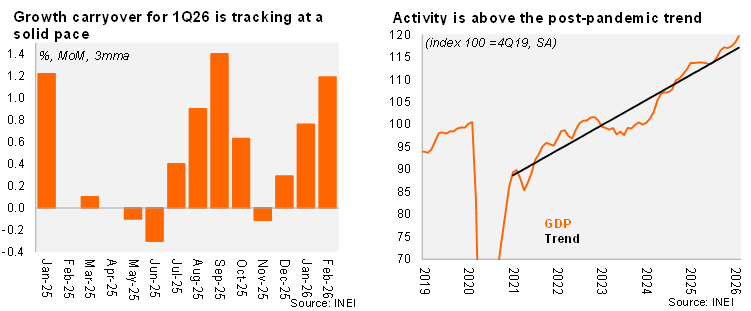
Peru’s monthly GDP proxy rose 3.7% YoY in February, above the Bloomberg median (3.1%), confirming continued macro resilience at the start of the year. On a sequential basis, and using INEI’s seasonally adjusted reference series, economic activity was broadly flat m/m, following two consecutive months of strong expansion.
At the sectoral level, the headline print was driven by solid momentum in manufacturing (+2.7% m/m), alongside continued gains in commerce (+1.1% m/m) and transport (+1.1% m/m). Additionally, the data reflected a partial normalization in fishing activity (+3.6% m/m) after prior weakness. These gains were partly offset by contractions in mining (-1.7% m/m) and a sharper decline in construction (-5.6% m/m).
The February reading implies a healthy growth carryover of 1.2% QoQ (seasonally adjusted) for 1Q2026, while full-year 2026 carryover stands at 1.5%, providing a supportive starting point for annual growth.
On the labor market, the Metropolitan Lima unemployment rate (3‑month moving average) increased to 6.8% in the rolling quarter to March, slightly above 6.6% a year earlier. Employment increased by 4.7% in March, adding 253,000 jobs over the past twelve months.
Our Take: Leading indicators such as imports of capital goods, cement consumption, and payment transactions continue to grow at a healthy clip, consistent with ongoing investment activity and resilient private consumption. That said, we expect some moderation in March activity, driven by transitory disruptions to local gas supply, which are likely to weigh on energy generation, manufacturing output, and potentially services activity. These effects should prove temporary, but may introduce short-term volatility in monthly prints. Looking ahead, our 2026 GDP growth forecast of 3.1% remains intact, though risks are skewed to the downside. Key headwinds include elevated global geopolitical uncertainty and adverse weather risks associated with a possible El Niño event, which could affect agriculture and fishing. The March economic activity report is scheduled for release on May 15.