2026/06/01 | Andrés Pérez M., Vittorio Peretti, Andrea Tellechea & Ignacio Martínez
According to the National Institute of Statistics and Informatics (INEI), consumer prices in Lima fell by 0.16% m/m in May, well below the market consensus of +0.1%, while broadly in line with our call of -0.1%, following two consecutive upside surprises.
The downside print was mainly driven by declines in food prices (-1.69%) and transport (-0.19%), while upward pressures persisted in housing and utilities (+1.04%), restaurants and hotels (+0.75%). Core inflation excluding food and energy rose by 0.09% m/m in May.
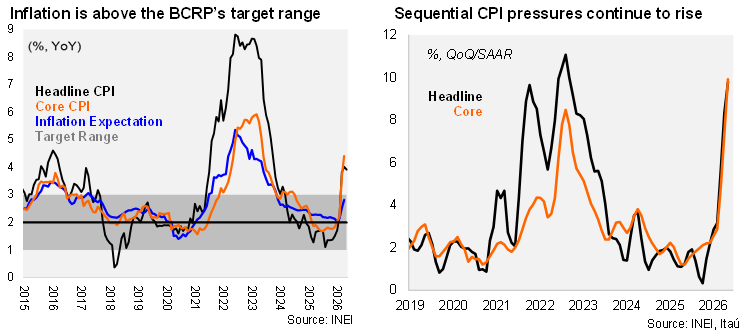
On an annual basis, headline inflation eased by 10bps to 3.91% YoY, remaining above the 2% ± 1% target range for a third consecutive month. Meanwhile, core inflation excluding food and energy edged up to 4.46% YoY in May, from 4.40% in April, marking its highest level since May 2023.
Sequential inflation pressures surge. Headline inflation rose to a sharp 9.8% QoQ (SAAR) in the rolling quarter ending in May, up from 5.7% in 1Q26. Core inflation followed a similar trend, climbing to 9.9% QoQ (SAAR), well above the 4.8% recorded in 1Q26.
Our take: Lower headline inflation in May offers only limited relief for the BCRP as the decline was largely driven by food prices, while core inflation continued to trend higher. We expect end-2026 inflation to reach 4.4%, driven by higher oil prices and sustained food price pressures in 2H26. Looking ahead to 2027, inflation should gradually converge toward the midpoint of the target range as supply-side shocks fade, although the disinflation process is likely to remain gradual. Against this backdrop, and with activity holding up, we expect the BCRP to resume its tightening cycle, delivering a cumulative 50bp in hikes by year-end, taking the policy rate to 4.75%. This Friday, the BCRP will release the May expectations survey, which will be key to gauging the evolution of inflation expectations.