2026/03/27 | Julia Passabom, Mariana Ramirez &
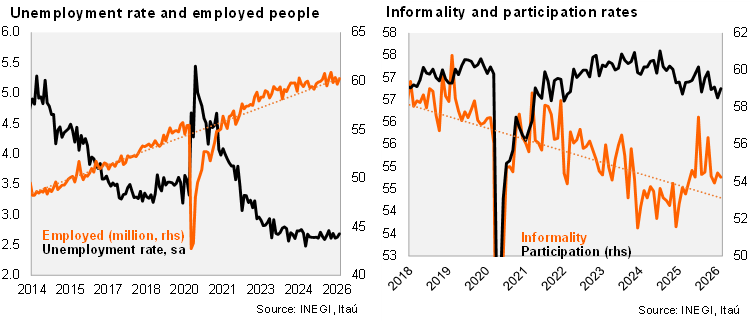
According to INEGI, the unemployment rate stood at 2.59% in non-seasonally adjusted terms in February, above Bloomberg’s market consensus of 2.50% but below January’s 2.70%. The decline was mainly driven by those unemployed for less than one month. Using seasonally adjusted data, the unemployment rate was 2.69% in February, up from 2.63% in January and from 2.63% a year ago.
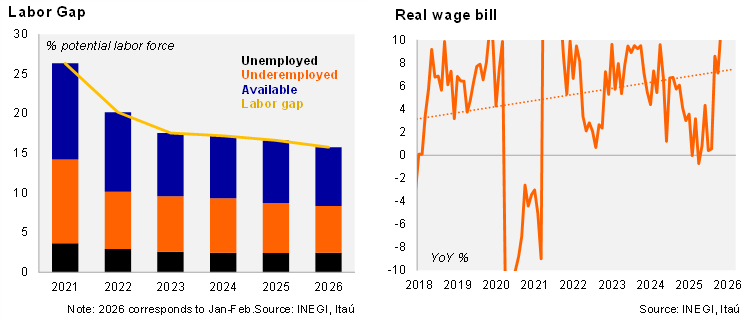
Compared to last year, the number of employed individuals increased by one million in February, largely within the informal sector. The labor participation rate stood at 59.0%, slightly higher than last year’s rate of 58.7% but still below the pre-pandemic average of 59.5%. The informality rate ticked up to 54.8% from 54.2% a year earlier, although the longer-term trend remains downward. Regarding wages, the real wage bill rose by 20.6% YoY, driven by a 12.9% YoY increase in the number of employed people and higher real wages during the month, which increased by 6.8% YoY.
Our view: The labor market continues to show resilience, underpinned by strong real wage growth and rising employment. This suggests that consumption will remain supported in the near term. In the second half of the year, we anticipate improved economic performance, assuming trade policy uncertainty subsides and the government increases public investment. Both factors could continue to support the labor market and consumption. We forecast an average unemployment rate of 2.7% in 2026.