2026/04/14 | Julia Passabom & Mariana Ramirez
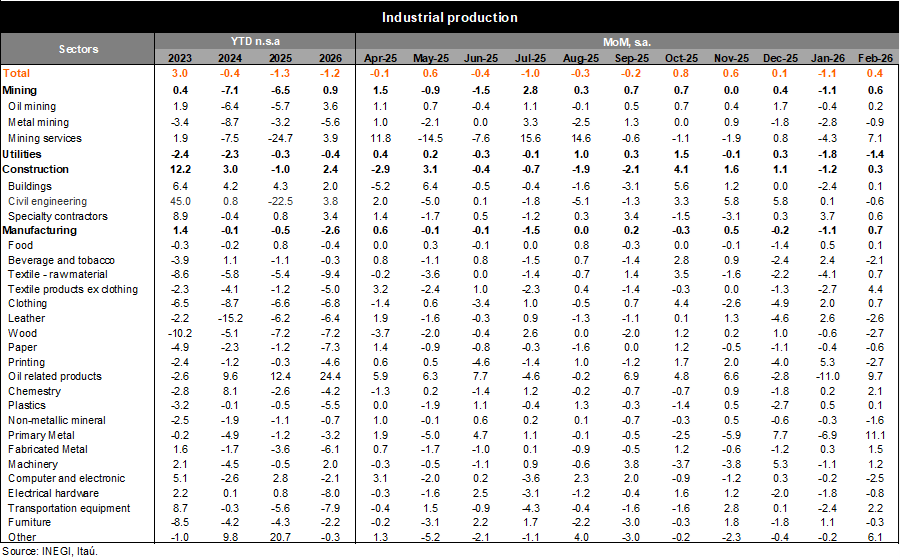
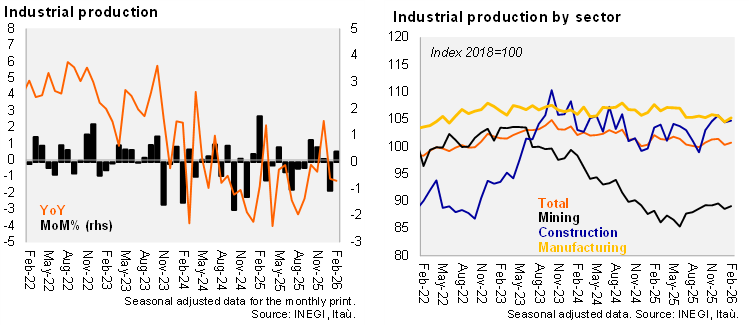
Industrial production (IP) decreased by 1.3% YoY in February, slightly below Bloomberg’s market consensus of -1.0% but in line with our call. The decline was driven primarily by manufacturing (-2.2% YoY), where 18 out of 21 subsectors contracted. In contrast, mining (+1.1% YoY) and construction (+0.8% YoY) provided modest offsets. Using seasonally adjusted figures, IP increased by 0.4% MoM, underperforming market expectations of 0.6% growth but exceeding INEGI’s nowcast of flat growth. The monthly increase was supported by expansions in mining (0.6% MoM, especially in mining services, following a weak performance since mid-2025), construction by 0.3% (with growth in buildings and specialty contractors, despite contraction in civil engineering), manufacturing by 0.7% (as 12 out of 21 subsectors increased). However, utilities declined by 1.4% MoM, marking a second consecutive monthly contraction and continuing to weigh on industry.
Our take: Despite February’s moderate rebound following a sharp contraction in January, industrial production remains fragile. On a quarterly basis, the sector is still dragged down by manufacturing (-1.6%, QoQ/SAAR) and utilities (-4.0%, QoQ/SAAR), underscoring the lack of a clear recovery trend. As a result, IP continues to underperform at the start of 2026, exerting a negative contribution to overall economic activity. Considering this release alongside complementary indicators -particularly soft domestic demand and weakening leading indicators- we forecast a GDP contraction of 0.3% QoQ in the first quarter of the year. This outcome introduces a downside bias to our current 2026 GDP forecast of 1.5% YoY. Looking ahead, momentum should improve in the second half of the year. Construction is expected to gradually improve, supported by increased public infrastructure spending in sectors such as energy, railways, highways, ports, health, water, education, and airports. Manufacturing, meanwhile, should gradually recover as trade uncertainty diminishes later in the year, allowing investment to stabilize.
See more details below