2026/02/24 | Julia Passabom, Mariana Ramirez & Ignacio Martínez
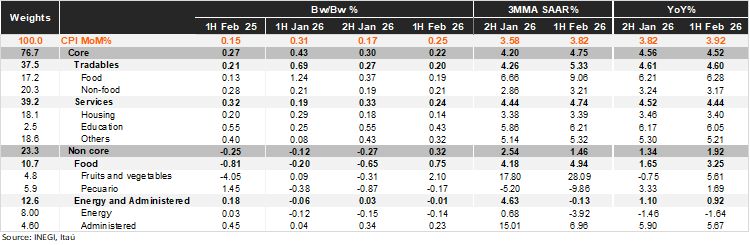
1H February CPI rose by 0.25% 2w/2w, above the Bloomberg median of 0.22% and our call of 0.15%. In contrast, Core CPI registered a 0.22% advance, underperforming market expectations (0.27%) but closer to our call of 0.25%. Within the core component, tradables rose 0.20% 2w/2w, with the food subcomponent rising 0.19%, and non-food increasing 0.21%. Meanwhile, Core services advanced 0.24% 2w/2w, with Housing, Education and Other increasing 0.14%, 0.43% and 0.32% respectively. Non-core CPI recorded a 0.32% rise, driven mainly by food prices (+0.75%), while Energy prices fell 0.14%.
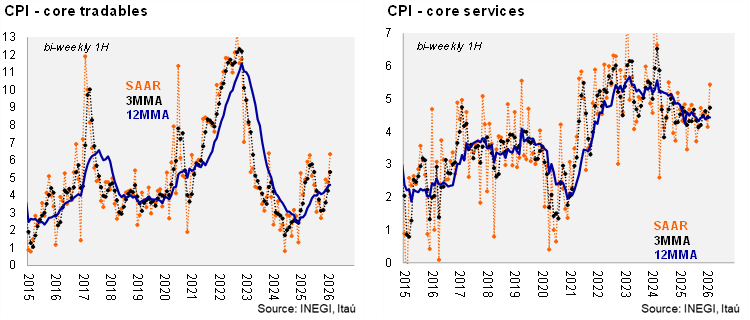
1H February CPI represents the third consecutive print where Headline inflation rises in annual terms. Headline inflation stood at 3.92% in the first half of February, remaining below the 4% threshold but increasing 0.1pp. from in 2H January, and completing 0.3pp of increases since 2Q Dec 25 (the last print where annual inflation eased). Core CPI fell slightly in annual terms, dropping to 4.52% from 4.56%, with tradables at 4.60% (broadly stable from 4.61%) and services at 4.44% (down from 4.52%). At the margin, core measures showed important increases: core CPI reached 4.75% on a 3MMA SAAR basis (4.20% in 2H Dec25), with tradables at 5.33% and services at 4.74%. Within services, pressures remain concentrated in education (6.21%), but the dynamics of the category of Others also demands attention with 5.32%.
Our take: Core CPI measures continue to demand further cautious, where the dynamics of Core Services at the margin presents still shows persistence. Taken together, we do not view this print as a benign inflation sign for Banxico. If second-round effects of the increase in excise taxes at the start of the year fail to materialize, along with expected economic slack and broadly stable inflation expectations, the Board may continue with its dovish stance and lower the policy the rate in upcoming meetings.