
2026/02/27 | Vittorio Peretti, Carolina Monzón, Juan Robayo & Angela Gonzalez
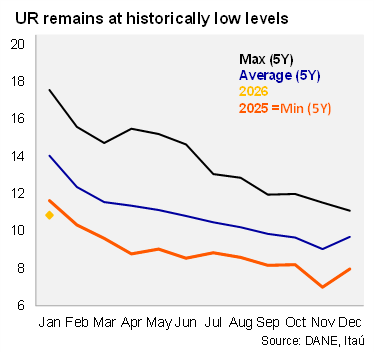
Labor market remains tight as effects of minimum wage adjustment still to materialize. According to DANE’s labor report for January, the national unemployment rate fell to 10.9%, a decrease of 0.8pp year on year. Meanwhile, the urban unemployment rate fell to 10.6%, a drop of 0.5pp year on year (Bloomberg market consensus and our 10.3% call). Employment increased by 1.3% YoY in January (+3.8% YoY in December), while the labor force rose by 0.8% YoY (+2.4% YoY in the previous month). The participation rate fell to 65.3% (+65.7% one year ago). Sequentially, employment fell by 0.2% (-0.5% in the previous month), while the unemployment rate (SA) sits at 8.5% (8.4% in January 2025). Meanwhile, the urban unemployment rate (SA) increased to 8.6% (from 8.1% in the previous month), which is below BanRep’s NAIRU of 9.7%.
Private and public salaried positions were the main job creators. In the quarter ending January, employment rose by 2.7% YoY (+3.6% in 4Q25). This annual increase was driven by a 4.7% YoY rise in private salaried posts (+5.2% in 4Q25), while public sector jobs increased by 2.2% YoY (+1.0% in 4Q25). Meanwhile, self-employment posts increased by 0.6% YoY, decelerating from the +2.2% registered in 4Q25. In the quarter ending January, manufacturing, IT and public administration were key job drivers, while commerce shed jobs.
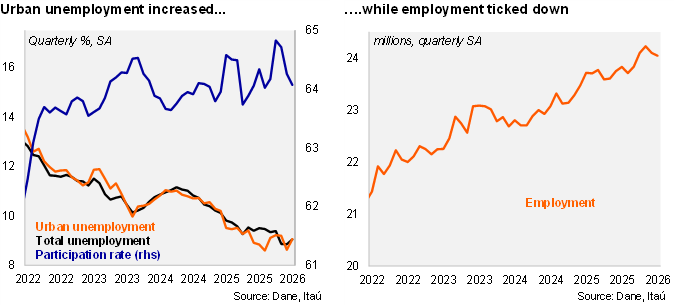
Our take: While the labor market remained strong during 2025, the sizable minimum wage hike is likely to raise the average unemployment rate this year to 10.2%. The sequential rise in urban unemployment dynamics may be a precursor to weaker hiring dynamics ahead.