
2026/05/19 | Vittorio Peretti, Carolina Monzón, Juan Robayo & Angela Gonzalez
The trade deficit came in at USD 0.5 billion in March, down by USD 0.3 billion over one year, while slightly above both the Bloomberg median and our call (USD 0.4 billion). During 1Q26, the trade deficit reached USD 3.1 billion (USD 4.6 billion in 4Q25). As a result, the rolling 12-month trade deficit reached USD 16.1 billion, below the USD 16.4 billion deficit recorded in 2025 (USD 10.8 billion in 2024). In March, total imports (FOB) increased by 11.6% YoY (+8.5% in February), boosted by consumption goods (66.5% YoY), manufacturing (+16.7% YoY), agricultural imports (+4.4% YoY), while exports rose by 20.9% in March (+11.6% in February), driven by non-traditional exports, coal and oil. At the margin, our seasonal adjustment shows the trade deficit in the quarter reached USD 12.6 billion (annualized; USD 17.9 billion in 4Q25).
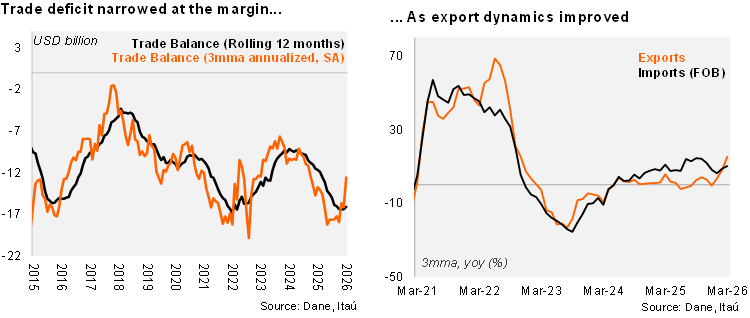
Consumption goods continue to drive import growth. During 1Q26, imports increased by 10.2% YoY (+8.2% YoY in 4Q25). Consumption goods rose by 32.8% YoY, with durable consumption goods growing 53.3% YoY, while non-durable consumption goods rose by 16.5% YoY. Transport equipment (+32.7% YoY) and construction materials (+12.9% YoY) were also key drivers and reflect the recovery of investment during the quarter. Imports excluding fuel and transport equipment rose 12% YoY (stable from 4Q25). At the margin, we estimate imports increased 10.2% QoQ/saar (-3.3% in 4Q25). During 1Q26, imports from the US accounted for 21.3% of the total (24.6% in 2024).
Exports increased at the margin. During 1Q26, exports increased by 15.3% YoY (-0.4% in 4Q25). The quarterly result was driven by non-traditional exports which increased 28.5% YoY and coal exports which rose by 19.4% YoY. Nevertheless, export gains were limited by the decline in ferronickel (-97% YoY) and coffee exports (-1.5% YoY). At the margin, exports increased by 60.3% QoQ/saar during the first quarter of the year (-10% in 4Q25). In 1Q26, the US accounted for 29.9% of total exports (29.6% in 2025).
Our Take: Strong domestic demand, particularly in durable goods, is boosting imports. However, higher oil prices and solid non-traditional goods sales are supporting an export recovery, helping to contain the trade deficit. We expect the current account deficit to reach 2.7% of GDP in 2026 (2.4% in 2025), despite solid remittance inflows.