
2026/03/30 | Vittorio Peretti, Carolina Monzón, Juan Robayo & Angela Gonzalez
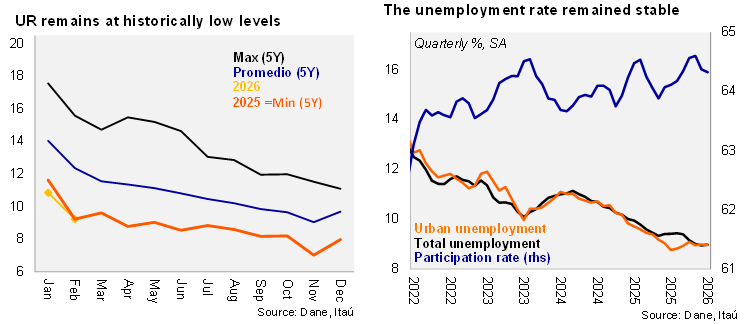
In February, employment increased sequentially and the unemployment rate remained low. According to DANE’s monthly labor report, the national unemployment rate fell to 9.2%, a 1.1pp decline year on year. The urban unemployment rate also fell to 9.2%, a drop of 0.6pp year on year, below the Bloomberg market consensus of 9.4% and our 9.3% call. Employment increased by 2.7% YoY in February (+1.4% YoY in January), while the labor force rose by 1.4% YoY (+0.5% YoY in the previous month). The participation rate remained stable at 64.7%. Sequentially, employment increased by 1.0% MoM (-0.2% MoM in the previous month), while the unemployment rate (SA) sat at 8.4%, falling -0.4pp from the previous month. The urban unemployment rate (SA) also dropped to 8.5% from 8.8% in the previous month, which is well below BanRep’s NAIRU of 9.7%.
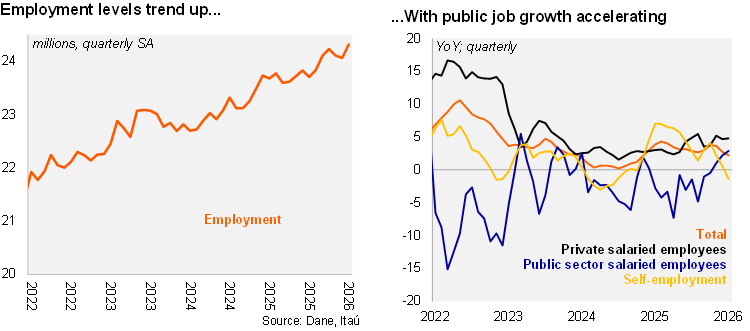
Private and public salaried positions were the main job creators. In the quarter ending February, employment rose by 2.2% YoY (+3.6% in 4Q25). This annual increase was driven by a 4.8% YoY rise in private salaried posts (+5.2% in 4Q25), while public sector jobs increased by 2.9% YoY (+1.0% in 4Q25). Meanwhile, self-employment fell by 1.4% YoY, down from the +2.2% registered in 4Q25. In the quarter ending in February, IT, manufacturing and public administration were key job drivers, while agriculture shed jobs.
Our take: Although the labor market remained strong during the first two months of the year, the sharp increase in the minimum wage, higher interest rates, and the heightened geopolitical uncertainty is expected to cool growth dynamics and push average unemployment up to 10.2% this year.