2026/02/27 | Andrés Pérez M., Vittorio Peretti, Andrea Tellechea & Ignacio Martínez
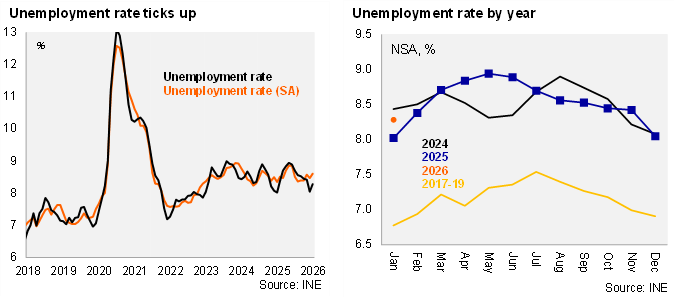
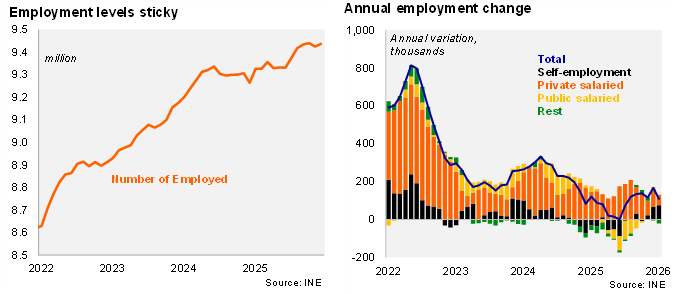
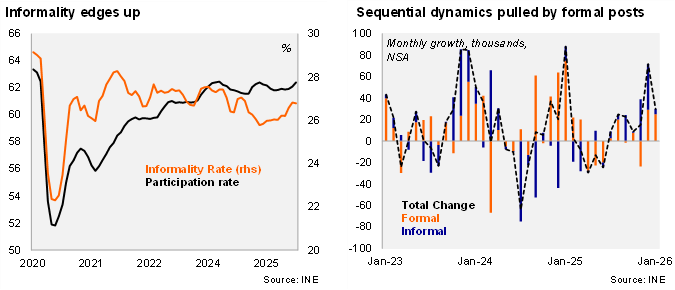
The unemployment rate reached 8.3% in the January quarter, up 0.3pp over one-year amid a swifter labor force recovery. The unemployment print came in above the Bloomberg median (8.1%; Itaú: 7.9%). Employment rose 1.2% YoY (in 1.8% in 4Q25), while the labor force increased 1.4% (1.8% in 7Q).On a seasonally adjusted basis (SA), employment levels were essentially flat at the margin. As a result, the unemployment rate (SA) rose by 0.1pp to 8.6%. Labor market informality sits at 26.8%, up 0.5pp over one year. While the labor market last year was characterized by upbeat formal job creation amid soft informal dynamics, data at the start of the year paints a reversal of this trend (informal posts: +78 thousand YoY; formal: 31 thousand). Administrative services, health and hospitality were key job drivers in January, while public administration agriculture and financial services destroyed posts.
Our Take: Weaker labor market dynamics mirror the soft activity close to last year and signs of a lackluster start to 2026. We expect GDP growth of 2.6% this year (2.3% in 2025), implying a notable sequential acceleration relative to last year. While private sentiment has rallied and the private investment pipeline continues to be revised, a propagation of favorable mining and energy investment dynamics to other sectors of the economy will be required to boost a labor market rebound. However, January credit data suggests the investment cycle has yet to spread as the stock of outstanding real bank credit in Chile contracted by 1.2% YoY at the start of the year, driven by ongoing contractions in commercial credit (-3.6%). The Central Bank’s labor demand proxy sits nearly 10% below last year, well below pre-pandemic levels. The Labor Directorate reported total layoffs based on administrative records increased by 10.8% YoY in December, reaching the highest monthly print since 2020, while unemployment insurance beneficiaries increased by 13% YoY in 4Q25. Finally, the BCCh’s quarterly business perception report noted that most companies, after a period of adjustments, had gone several quarters without altering staffing levels. We expect an average unemployment rate of 8.3% this year (8.5% in 2025; BCCh’s NAIRU range estimate is 7.5-8.5%).