2026/05/29 | Andrés Pérez M., Vittorio Peretti, Andrea Tellechea & Ignacio Martínez
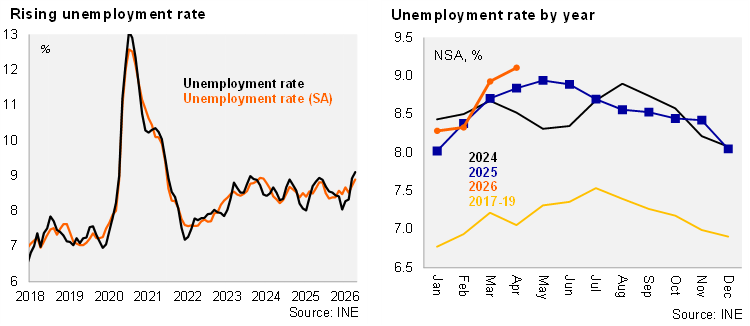
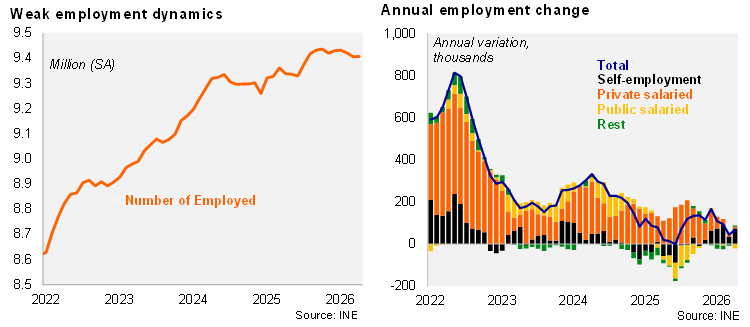
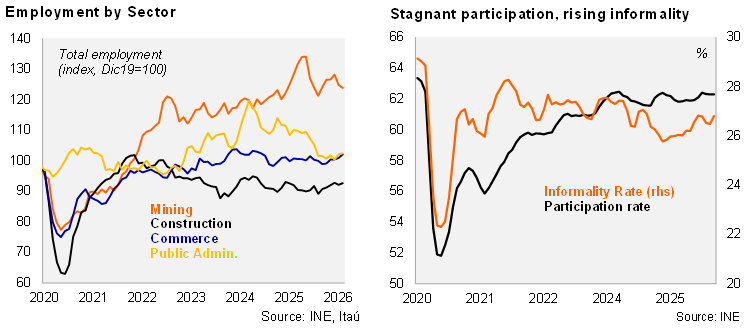
According to the National Statistics Institute (INE), the unemployment rate during the quarter ending in April was 9.1%, above market estimates (Bloomberg consensus and Itaú: 9.0%). The unemployment rate sits 0.2pp above that recorded in corresponding quarter of last year. Adjusting for seasonal factors, the unemployment rate reached 8.9% (8.5% in 4Q25). Labor force participation reached 62.3%, up 0.1pp year-on-year. Total employment increased by 0.7% over the past twelve months (0.5% in 1Q26), largely driven by a 4.5% annual rise in informal employment, while formal jobs declined by 0.6%. The informality rate rose 1.0pp over the last year to 26.8%. Overall, the labor force rose by 1.0% (0.7% in 1Q26). By sector, health services (5.9%) and manufacturing (4.1%) posted the most relevant growth rates. Total hours worked dropped 0.2% year-on-year and average hours declined 0.9% to 36.2 hours. The expanded unemployment measure (including potential labor force) rose to 17.1% (+0.3pp), pointing to significant underutilized labor with women disproportionately affected.
Our Take: The data continue to point to a labor market with significant slack, still absorbing the unprecedented increases in labor costs seen in recent years, and consistent with activity indicators that have come in weaker than expected. Female unemployment rate reached 10.5%, rates not seen beyond periods of significant shocks. In fact, some indicators of labor demand remain quite depressed, while measures of job destruction — such as unemployment insurance beneficiaries — increased 11% year‑on‑year in March. We expect the April Imacec to contract by 1% year-over-year. In this context, public policies that help mitigate further increases in labor costs would support a gradual recovery in Chile’s labor market. This reinforces the importance of swiftly advancing policies such as the tax credit aimed at encouraging formal employment and universal childcare, while the minimum wage proposal would link adjustments to past inflation. Labor market slack, together with the erosion of real incomes due to higher expected inflation, is constraining private consumption growth this year. Reviving private investment is essential. We expect the unemployment to be broadly unchanged from last year’s 8.5% and have a significant downside bias to our official GDP growth call of 2.1% for this year.