
2026/03/30 | Andrés Pérez M., Vittorio Peretti, Andrea Tellechea & Ignacio Martínez
According to the National Statistics Institute (INE), the unemployment rate for the moving quarter ending in February reached 8.3%, slightly below the market expectation of 8.4% (Itaú: 8.5%) and down 0.1 percentage points compared with February 2024. Labor force grew 1.0% YoY (1.4% in January), as did total employment (1.2% in January), driven mainly by the expansion of informal jobs (+2.8%), while formal employment grew 0.3%. By economic activity, health and professional services were key sectors to the annual grow, while public administration destroyed posts. The labor informality rate stood at 26.5%, an increase of 0.4 percentage points over twelve months. At the margin, the unemployment rate reached 8.5%, one-tenth lower than the previous month, although total employment fell 0.1% MoM (0% in January), remaining near the upper limit of the estimated NAIRU range.
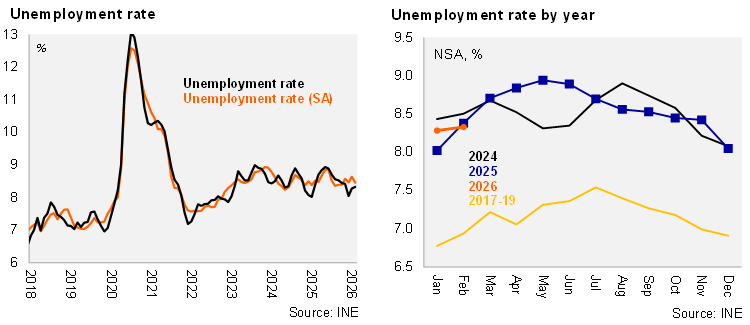
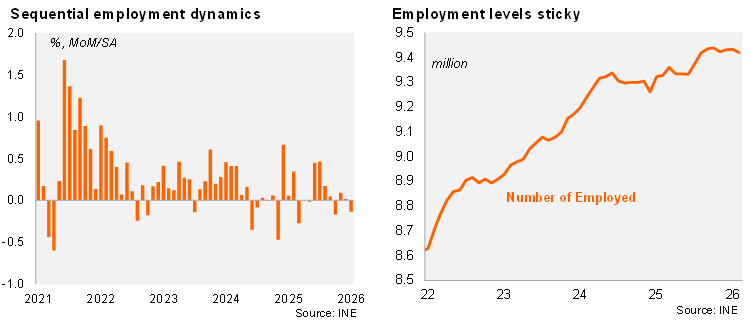
Our take: The labor data reflects a lack of momentum, with job levels roughly stagnant over the last seven months. Unemployment insurance beneficiaries rose 5.9% YoY in January, reinforcing signs of underlying weakness in labor demand. With wage growth set to slow further as inflation spikes, weak activity dynamics are set to persist in the short-term. We expect GDP growth of 2.1% this year (2.5% last year). We preliminary expect the 1Q26 unemployment rate to come in at 8.6% (down 0.1pp from 1Q25). With regards to policy, the Kast administration withdrew from Congress the collective bargaining bill (presented in January 2026) that looked to modify the labor code to allow for collective bargaining to take place at the sector level. Regarding the working week, the government has signaled it will keep the rollout timetable of the 40‑hour law but introduce adjustments to its implementation that include greater flexibility in daily working-hour bands, and changes to how meal breaks are counted within the workday. The administration is expected to detail a National Reconstruction bill, that includes an employment subsidy.