
ARGENTINA – Trade balance outlook turns more constructive
2026/04/20 | Diego Ciongo & Soledad Castagna
Argentina recorded a USD 2.5 billion trade surplus in March, a sharp improvement from the USD 0.6 billion surplus a year earlier and well above market expectations (USD 1.2 billion, central bank survey). On a rolling basis, the 12‑month trade surplus widened to USD 15.8 billion, up from USD 13.9 billion in February. Near‑term momentum also strengthened, with the seasonally adjusted annualized trade balance expanding to USD 23.5 billion, from USD 19.4 billion in the previous month.
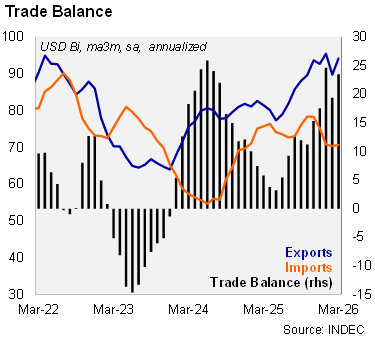
Export performance strengthened in 1Q26, driven mainly by primary goods. Total exports rose 16.9% yoy, accelerating from 14.4% in 4Q25. Agricultural exports (including processed products) increased 17.6% yoy, just below the 18.1% pace recorded in the prior quarter. Exports of other industrial products surged 23.6% yoy, a significant acceleration from 6.1% in 4Q25. Sequential dynamics were also supportive, with exports rising 6.4% qoq (saar) in March.
Imports contracted sharply, reinforcing the trade surplus and signaling softer domestic demand. Imports declined 7.3% yoy in 1Q26, reversing the 9.4% yoy expansion in 4Q25. Capital goods and parts imports plunged 16.6% yoy, while consumer goods imports (including vehicles) rose 10.6% yoy. Intermediate goods imports fell 5.7% yoy. On a sequential basis, imports dropped a steep 22.0% qoq (saar) in March.
The energy trade balance continued to improve. The rolling 12‑month energy surplus reached USD 8.1 billion in March, up from USD 7.8 billion in December. Energy exports grew 1.9% yoy in 1Q26, while oil imports declined sharply (35.7% yoy).
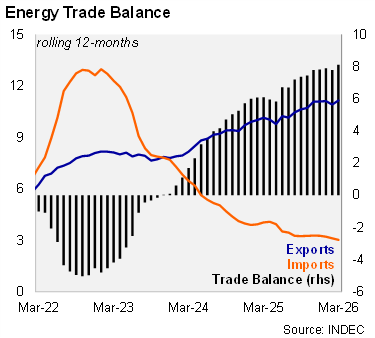
Our take: We recently raised our 2026 trade surplus forecast to USD 14 billion, from USD 10 billion previously, reflecting higher international oil prices and more favorable prospects for the soybean harvest. Additionally, weaker‑than‑expected imports early in the year provide further upside to the trade outlook. That said, persistent weakness in capital goods imports remains a concern, pointing to a delayed recovery in investment. April trade data will be released on May 20.