
2026/04/16 | Diego Ciongo & Soledad Castagna
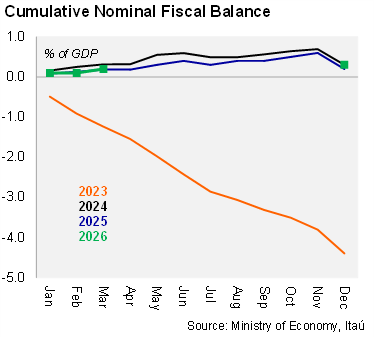
Argentina posted another fiscal surplus in March. The primary surplus amounted to 0.5% of GDP in 1Q26, while the overall fiscal balance—including interest payments—registered a surplus of 0.2% of GDP. Both figures are broadly in line with those recorded in the same period of 2025.
Real tax revenues declined in 1Q26. Total real revenues fell by 4.9% YoY in 1Q26, following a 6.4% contraction in 4Q25. Real tax collection declined by 7.8% YoY during the quarter, slightly worse than the 7.3% drop observed in the previous quarter. The weak performance continues to reflect the impact of lower export duties—following their temporary suspension in 4Q25—as well as declines in VAT and income tax, likely associated with still‑soft domestic consumption.
Primary expenditures continued to adjust downward. Primary expenditures declined by 4.8% YoY in real terms in 1Q26, extending the 3.9% contraction recorded in 4Q25. Public sector payrolls fell by 7.9% YoY (‑12.3% in 4Q25), partly reflecting higher inflation at the margin. Transfers to provinces dropped sharply, down 38.2% YoY (‑21.4% in 4Q25), while capital expenditure declined by 25.7% YoY, following a modest 2.4% fall in the previous quarter. By contrast, energy subsidies increased by 84.3% YoY in real terms, reversing a 5.3% decline in 4Q25, while pension spending rose by 2.5% YoY in real terms (+6.1% in 4Q25), also influenced by higher inflation at the margin.
Our Take: Our 2026 primary surplus forecast stands at 1.5% of GDP, in line with the official target outlined in the 2026 Budget. The outlook continues to be underpinned by disciplined fiscal execution, despite ongoing pressures on the revenue side.