
2026/03/16 | Diego Ciongo & Soledad Castagna
Argentina posted a trade surplus of USD 0.8 billion in February, improving from the USD 0.3 billion surplus recorded a year earlier but undershooting market expectations (USD 1.0 billion, according to the central bank survey). On a rolling basis, the 12‑month trade balance widened to a surplus of USD 13.9 billion, up from USD 13.3 billion in January. However, near‑term momentum softened: the seasonally adjusted annualized trade balance narrowed to USD 19.7 billion in February, from USD 25.1 billion in the prior month.
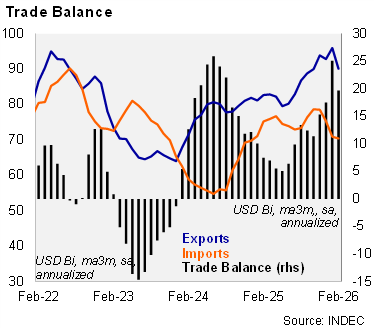
Exports continued to grow in the quarter ended in February, supported by primary goods. Total exports increased by 8.3% yoy, decelerating from a 14.4% gain in 4Q25. Agricultural exports (including processed agricultural goods) rose by 11.1% yoy, down from 18.1% in the previous quarter. Exports of other industrial products gained 10.8% yoy, accelerating from 6.1% in 4Q25. That said, sequential dynamics weakened, with exports falling 15.2% qoq at a seasonally adjusted annualized rate in February.
Imports contracted sharply, reinforcing the surplus and pointing to softer domestic demand. Total imports declined by 7.1% yoy in the quarter ended in February, following a 9.4% yoy expansion in 4Q25. Capital goods and parts imports fell by 15.3% yoy, while consumer goods imports (including vehicles) increased by 13.9% yoy. Imports of intermediate goods dropped by 10.5% yoy. On a sequential basis, imports fell a steep 35.4% qoq (saar) in February.
The energy trade surplus remained broadly stable. The rolling 12‑month energy balance stood at USD 7.8 billion in February, essentially unchanged since November. Energy exports declined by 7.0% yoy in the quarter, while oil imports fell sharply, down 24.1% yoy.
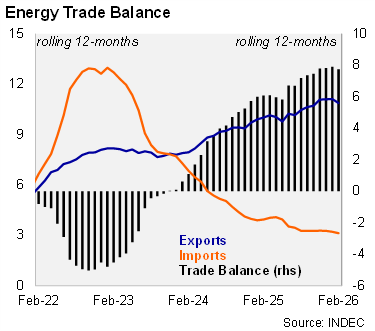
Our take: We maintain our 2026 trade surplus forecast at USD 10.0 billion, but risks are skewed to the upside. Higher oil production and elevated prices since the conflict in the Middle East could materially strengthen the energy trade balance. Historically, a 10% increase in oil prices has boosted Argentina’s energy trade balance by roughly USD 0.8 billion over a 12‑month horizon. In addition, weaker‑than‑expected imports early in the year provide further support to our view. Lingering weakness in the imports of capital goods are a source of concern, pointing to a delay in the recovery of investment. March trade figures are due on April 20.