2025/12/01 | Andrés Pérez M., Vittorio Peretti, Andrea Tellechea & Ignacio Martínez
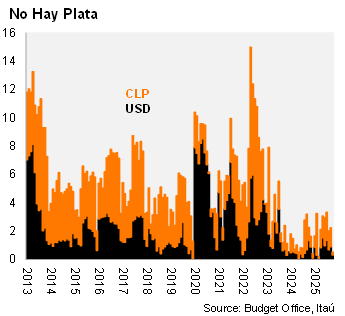
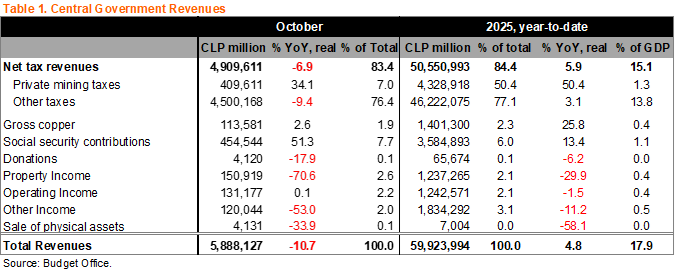
The Central Government’s real revenues unexpectedly plunged by 10.7% YoY in October, following a solid revenue recovery during 3Q25. Cyclically-related real revenues (tributación resto contribuyentes, comprising roughly 80% of total revenues) fell by 9.4% YoY, presumably due to base effects, taking these revenues below our forecast for the month, and hence taking cumulative misses in the year to roughly 2% (equivalent to roughly 0.3% of GDP, see chart). Private mining revenue roared back in October, rising by 34.1% YoY, taking revenues in the year up by 50.4% YoY, reflecting the first full year of the new mining royalty law, elevated copper prices, and greater copper production. Total real revenues accumulated in the year through October have increased by 4.8% YoY (6.8% as of September), edging down below the MoF’s watered-down revenue forecast (6.8%).
Real spending rose by 9.1%YoY in October. Current expenditure increased by 6.6%, mainly driven by higher personnel spending and interest payments; current expenditures year-to-date are up by 3.3% accumulating 84.5% of the annual budget, slightly above 2024's pace. Capital expenditure (mainly transfers to regions) rose by 25.7% YoY in October leading to a cumulative rise in the year of 5.5%, taking this component’s expenditure to 68.3% of the annual budget, above previous years. Capital spending is likely to halt by yearend to meet spending forecasts and low liquid cash balances. Total spending in the year through October has increased by 3.6%, still above the 2.6% official forecast.
October’s monthly fiscal balance reached -0.4% of GDP, well above the balanced monthly budgets of October during 2023 and 2024. The cumulative fiscal balance through October rose to a deficit of 2.3% of GDP, a slightly smaller deficit than the 2.5% through October 2024 (see chart).
The 12-month rolling fiscal deficit rose to 2.7% of GDP. On a 12-month moving average basis as of the end of October, the central government’s revenues fell by 30bps to 21.8% of GDP, and expenditures rose by 10bps to 24.5%, leading to a nominal deficit of 2.7%, improving from 3.7% of GDP a year earlier. We expect a gradual narrowing of the deficit, primarily due to an improvement in revenues.
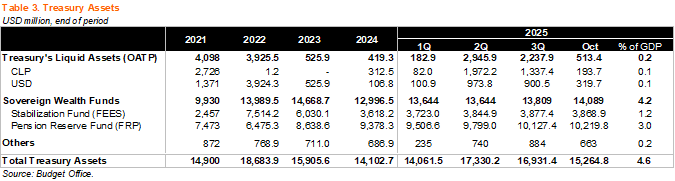
Liquid assets at the Treasury fell back to critical levels in October. Liquid assets in the Treasury fell in October to USD512 million (from USD2.2 billion in 2Q), the lowest October level since at least 2013. It is no surprise that in this context, the MoF announced a revised larger issuance local currency plan for 4Q25. AUM in the sovereign wealth funds were little changed (see table).
Our take:
• An unwelcome surprise at the start of 4Q25. Even though solid revenue improvement throughout most of the year, especially in 3Q, led us to be more constructive than consensus, October's data leads us to moderate our view. Moreover, spending was unusually strong, especially in capital transfers. For context, the October 2025 balance, was as negative as the cumulative 4Q25 deficit (!). As a result, spending growth will have to be materially contained during the final quarter of the year. We will revise our 2025 nominal deficit forecast of 2.0% up towards 2.5 - 2.6% of GDP. The MoF will miss the structural deficit target again this year, eroding the credibility in Chile’s fiscal institutional framework.
• On the financing front: The MoF concluded its 2025 gross financing plan (as mentioned earlier revised from USD16 billion to USD16.7 billion, see our note on the issue here). The 2026 budget bill requests gross debt issuance for next calendar year for a total of USD17.4 billion (and an additional USD600 million in loans from multilaterals). The MoF is likely to announce their issuance plan in early 2026, and kick off issuance in early January with a sizable foreign currency issuance, followed by local currency auctions.
• On policy and reforms: Congress finally approved the 2026 budget, a few days prior to the November 29 deadline. Despite calls for spending cuts, in the context of skepticism on revenue forecasts, real expenditure growth was maintained at 1.7% YoY (total budget at roughly USD90 billion, 25.7% of GDP). In the end, reallocations within the budget for a total of USD2.8 billion (0.8% of GDP, 3% of the budget) facilitated the bill's approval. The 2026 structural deficit is projected at 1.1% of GDP. Separately, the revenue-neutral tax reform – according to official estimates – presented by the administration in July (during former Minister Marcel’s tenure), was split; measures that postpone property taxes for households, among others were presented in a separate bill. Measures that enhance this year’s revenues – so called corrective measures – failed to advance materially in Congress. The bill that presents minor modifications to the management of the sovereign wealth funds has yet to be discussed in Congress (see our report on the issue).
• Upcoming data: The Budget Office will release November’s fiscal data on December 30.